

By Dr. Saijyot Raut, Consultant Spine Surgeon at One Spine
22/07/2026 | 8 Min read
| Exercise | Primary Benefit | Sets / Reps |
|---|---|---|
|
Chin Tucks |
Deep neck flexor activation, posture correction
|
3 sets × 10 reps |
|
Neck Flexion / Extension |
Preserve cervical range of motion
|
8 to 10 reps each way
|
|
Lateral Neck Flexion |
Stretch scalenes, upper trapezius
|
3 reps × 20 to 30 sec hold
|
|
Cervical Rotation |
Maintain rotational mobility
|
8 to 10 reps each side |
|
Shoulder Rolls & Squeezes |
Release upper back tension
|
10 to 15 reps |
|
Isometric Strengthening |
Build cervical muscle support without movement stress |
3 reps × 5 to 7 sec hold |
|
Wall Angels |
Thoracic mobility, postural alignment |
10 reps |
If you’ve been diagnosed with cervical spondylosis or even if you’re just living with that persistent neck stiffness and ache that never quite goes away one of the first things you probably want to know is whether movement is safe or whether you should be resting instead.
The short answer: movement, done correctly is almost always better than rest.
Cervical spondylosis is a degenerative condition. The discs and joints in your neck gradually wear down over time and while that process can’t be reversed, the right exercises can meaningfully reduce pain, improve mobility and protect your neck from getting worse. The key word there is right. Not all neck exercises are appropriate, and doing the wrong ones especially aggressively can flare symptoms rather than calm them.
What follows is a clinically grounded guide to seven of the safest and most effective exercises for cervical spondylosis, explained in a way that’s actually useful whether you’ve just been diagnosed or you’ve been managing this condition for years.
Before getting into the exercises a few things matter a lot:
Pain is a signal, not a challenge. If any movement causes sharp pain, radiating pain into your arm, or worsening numbness or tingling, stop and consult your spine specialist. Mild discomfort or a gentle pulling sensation is generally acceptable. Sharp, shooting, or electric pain is not.
Consistency beats intensity. With cervical spondylosis, doing gentle exercises daily is far more effective than doing intense exercises occasionally. The goal is to build a habit, not break a record.
Warm up first. A warm shower or a heating pad on the neck for 10 minutes before exercising helps loosen stiff muscles and makes movement more comfortable.
Posture is part of treatment. If you’re sitting hunched forward while doing these exercises, you’re partially working against yourself. Start from a neutral, upright position every time.
If there’s one exercise that spine specialists and physiotherapists recommend more than any other for cervical spondylosis, this is it. The chin tuck is simple, can be done anywhere, and directly targets the deep cervical flexor muscles the group that often weakens in people with neck degeneration, contributing to the forward head posture that places enormous load on the lower cervical vertebrae.
How to do it:
Sit or stand with your spine tall. Without tilting your head up or down, gently draw your chin straight back as if you’re making a “double chin.” You should feel a mild stretch at the base of your skull and a gentle activation along the front of your neck. Hold for 5 seconds, then release.
Repeat 10 times, 2 to 3 sets daily.
This movement essentially repositions the head directly over the shoulders, reducing the mechanical stress on the C5 C7 region where spondylotic changes most commonly occur.
Controlled, gentle cervical flexion and extension help preserve the range of motion you still have and prevent the stiffness that tends to worsen over time when the neck is held in one position too long.
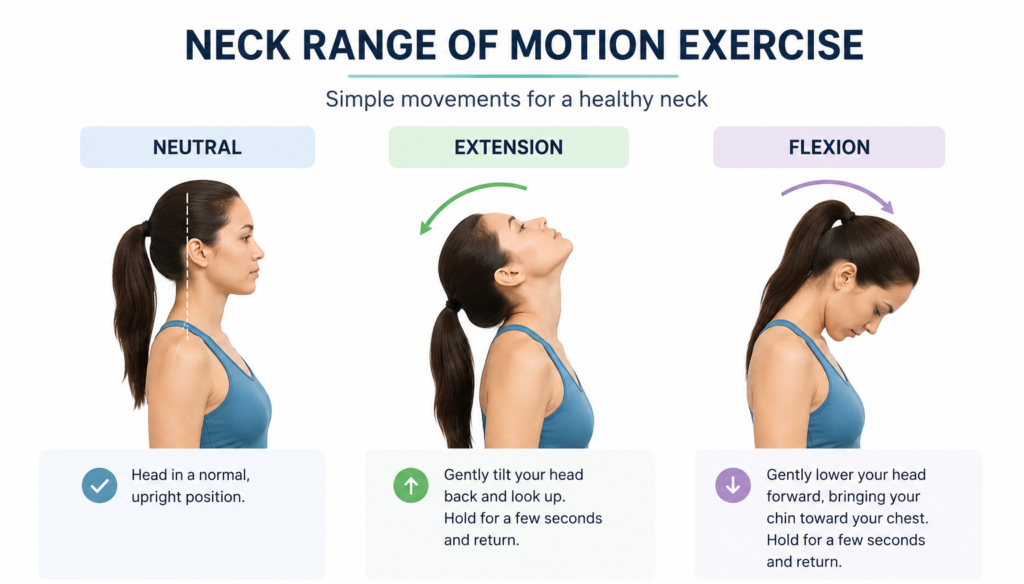
How to do it:
Sitting upright, slowly drop your chin toward your chest as far as comfortably possible. Hold for 3 to 5 seconds. Then slowly return to neutral and gently look upward only to the point where it’s comfortable, never forcing the movement. Hold for 3 to 5 seconds.
Repeat 8 to 10 times, once or twice daily.
A few caveats worth stating clearly: if extension (looking up) causes dizziness, pain down your arm or any neurological symptoms, skip that direction entirely and discuss it with your doctor. Some patients with significant foraminal narrowing find extension provocative and that’s important diagnostic information not something to push through
The muscles running along the sides of the neck particularly the scalenes and upper trapezius tend to become chronically tight in cervical spondylosis, pulling the cervical spine unevenly and contributing to one-sided neck pain and headaches
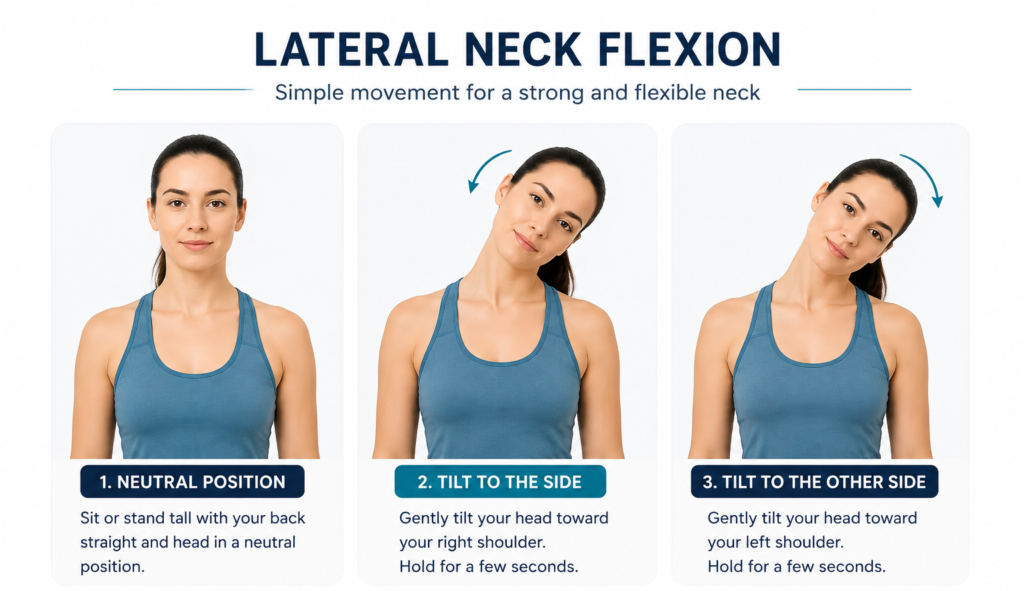
How to do it:
Sitting upright with your shoulders relaxed and level, slowly tilt your right ear toward your right shoulder. Don’t lift the shoulder to meet your ear keep it down. You should feel a gentle stretch along the left side of your neck. Hold for 20 to 30 seconds, then return to center. Repeat on the left side.
Do 3 repetitions on each side.
If you want to deepen the stretch slightly, you can place your right hand gently on the left side of your head but use only the weight of your hand, never actively pulling.
Rotation the ability to turn your head to check your blind spot or look over your shoulder is often one of the first movements that becomes limited and uncomfortable in cervical spondylosis. Gentle rotational exercises help maintain this functional range of motion.
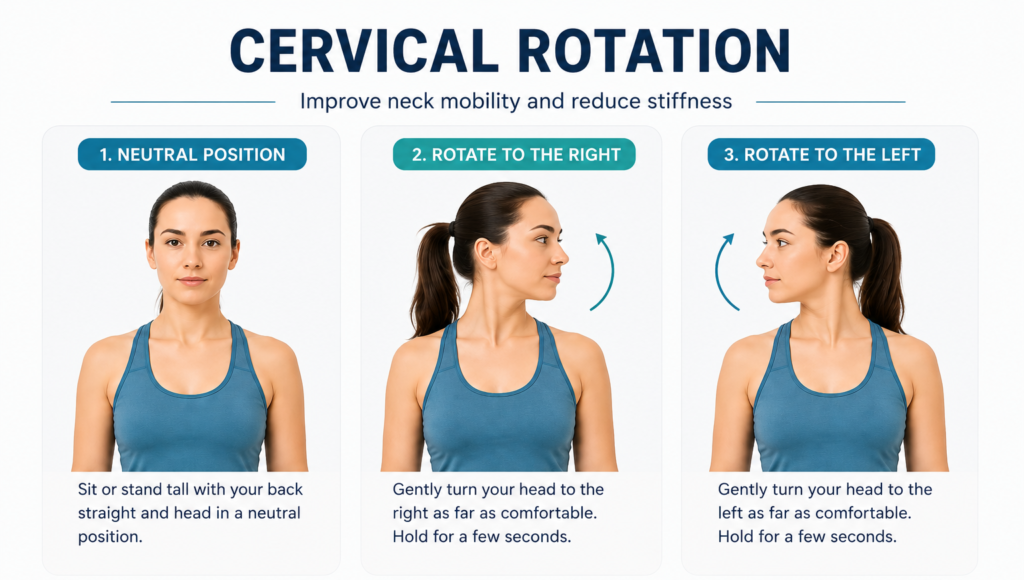
How to do it:
From a neutral seated position, slowly rotate your head to the right, leading with your chin. Move only as far as comfortable, without forcing the end range. Hold for 5 seconds. Return to center, then rotate left.
Repeat 8 to 10 times each direction.
Keep the movement slow and deliberate. Quick, jerky neck rotations are counterproductive and can aggravate already-irritated facet joints.
This one might surprise you these aren’t technically neck exercises for cervical spondylosis in the direct sense, but they address one of the most overlooked contributors to cervical pain: upper back and shoulder tension.
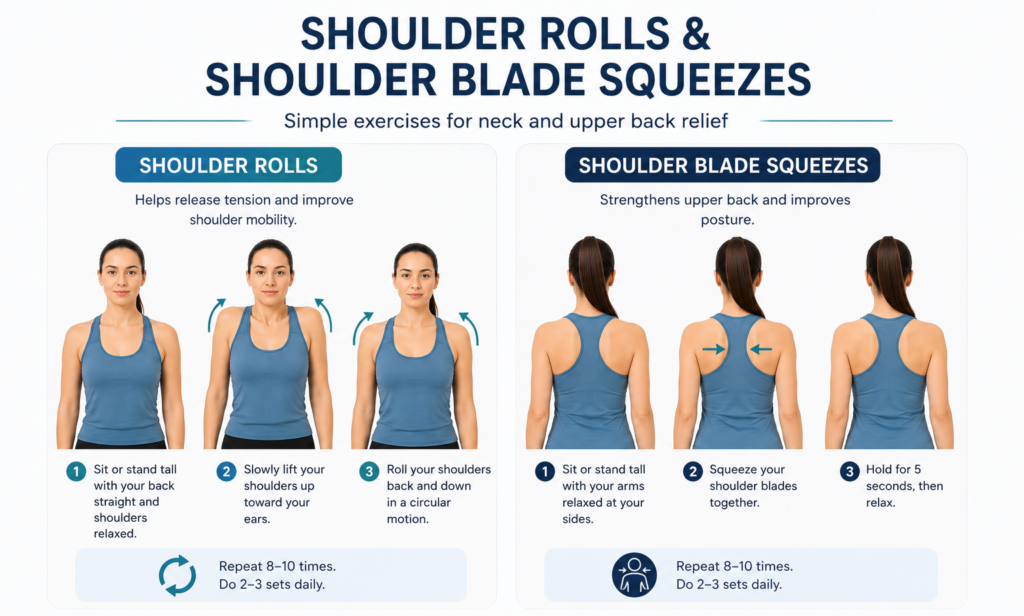
The trapezius, rhomboids and levator scapulae all attach to or influence the cervical spine. When these muscles are chronically tight or weak, they alter the mechanics of the entire neck region. Releasing and strengthening this area indirectly takes load off the cervical vertebrae.
Shoulder rolls: Slowly roll your shoulders backward in a large, controlled circle up, back, down and forward. Do 10 repetitions, then reverse direction.
Shoulder blade squeezes: Sit tall, arms at your sides. Gently squeeze your shoulder blades together and hold for 5 seconds. Release fully. Repeat 10 to 15 times.
These are particularly helpful for people who work at a desk, as prolonged sitting tends to collapse the upper back and pull the neck forward a posture that significantly increases compressive load on the cervical discs.
Isometric exercises are those where the muscle contracts without the joint actually moving and they are ideal for cervical spondylosis because they build strength without creating the shear forces that come with movement based exercises.
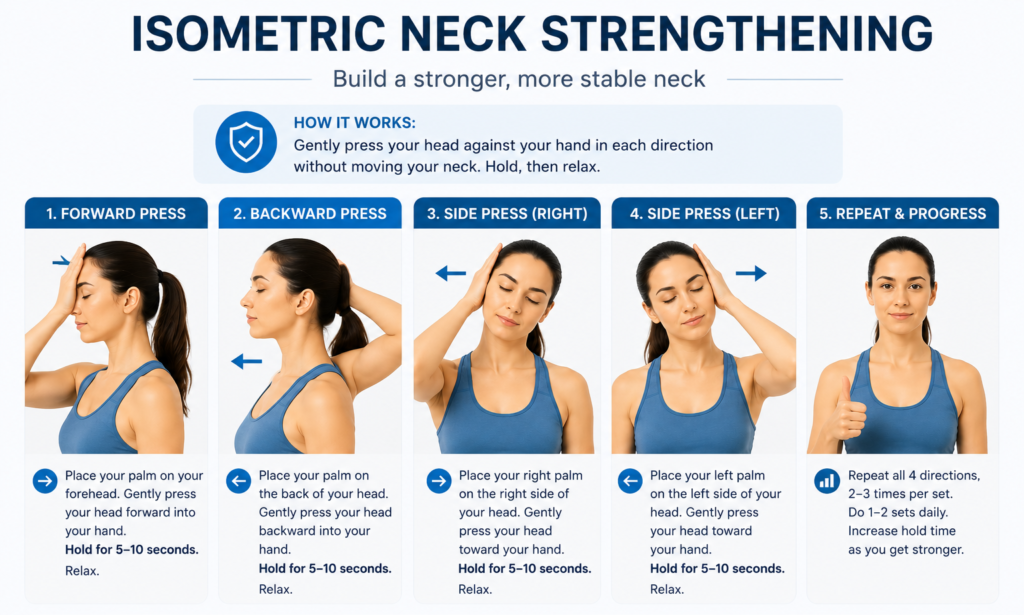
How to do it:
Flexion resistance: Place your palm on your forehead. Gently push your head forward against your hand, while your hand resists without letting the head actually move. Hold for 5 to 7 seconds. Release.
Extension resistance: Clasp your hands behind your head. Push your head backward against your hands, while your hands resist. Hold for 5 to 10 seconds.
Lateral resistance: Place your right palm against the right side of your head. Push your head sideways into your hand, while your hand resists. Hold for 5 to 10 seconds. Repeat on the left.
Do 3 repetitions in each direction, once daily.
These exercises build the deep stabilizing musculature around the cervical spine without stressing the degenerated discs or facet joints. They’re often the safest entry point for patients with significant spondylotic changes who find active range-of-motion exercises uncomfortable.
Cervical spondylosis rarely exists in isolation from thoracic stiffness. The mid back and the neck are mechanically linked when the thoracic spine loses its normal curve and becomes stiff, the cervical spine compensates by moving more than it should. Over time, this compensation accelerates degenerative changes in the neck.
Wall angels address this by mobilizing the thoracic spine and training the postural muscles that keep the head, shoulders and spine properly aligned.
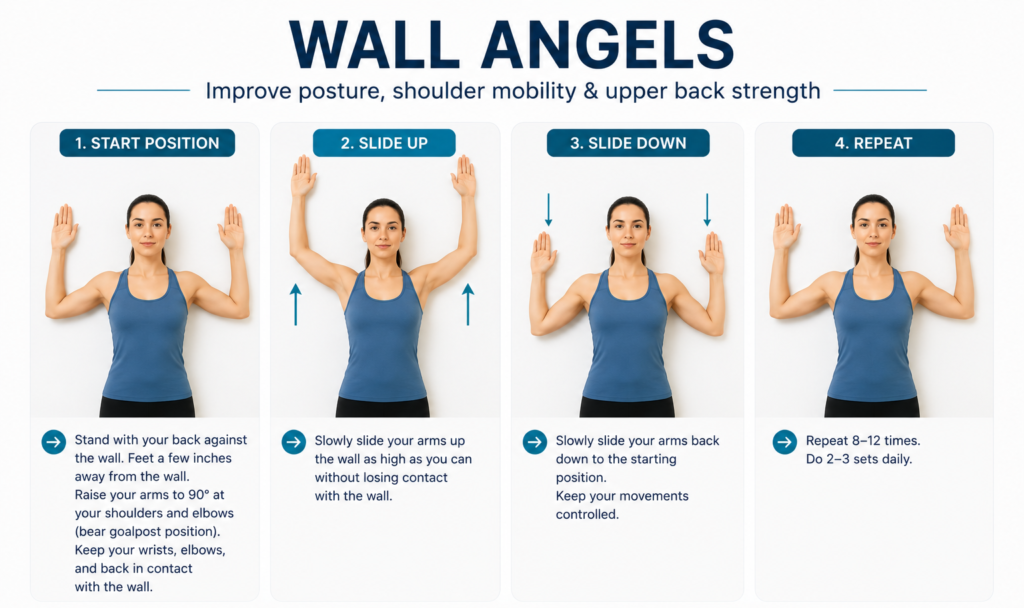
How to do it:
Stand with your back against a wall, feet about 6 inches away. Press your lower back, upper back, and the back of your head gently against the wall. Raise your arms like hands up position elbows at shoulder height, bent to 90 degrees, backs of hands touching the wall. Slowly slide your arms upward along the wall as high as you can while keeping your elbows and wrists in contact with the wall. Lower back down.
Repeat 10 times, once daily.
Many patients find this surprisingly difficult keeping the arms and head against the wall while moving reveals just how tight the thoracic and shoulder region has become. That tightness is directly relevant to their neck pain.
Living with cervical spondylosis is genuinely manageable for most people. The condition is common, it’s well understood, and there are clear, evidence-backed strategies to reduce its impact on your life. Exercise is central to that strategy not as a temporary fix, but as an ongoing habit that keeps your neck functional and pain under control.
The seven exercises described here are a solid, safe starting point. But they work best when they’re part of a broader approach that includes good posture habits, appropriate ergonomic adjustments, and regular follow-up with a spine specialist who knows your specific case.
If your symptoms are more complex if you’re experiencing arm pain, hand weakness or balance issues alongside your neck pain please don’t manage this on your own. Those symptoms suggest nerve involvement that warrants a proper clinical evaluation before any exercise program is started.
Your neck supports your head every hour of every day. Taking care of it proactively is one of the most worthwhile things you can do for your long-term health.
Verified by:

M.S ( Ortho), F MISS, F CV
Dr.Saijyot Raut is a consultant spine surgeon with 10+ years of expertise in minimally invasive spine surgery, scoliosis and complex spinal disorders. He is part of One Spine team which has branches all over Mumbai and practises across leading hospitals in Mumbai
Most mild to moderate neck pain responds well to a combination of heat or cold therapy, gentle cervical stretching, posture correction and proper sleep positioning. Applying a cold pack within the first 24 hours of a strain helps control inflammation, while heat works better for chronic stiffness by relaxing tight muscles and improving blood flow. Pairing these with daily neck stretches and ergonomic adjustments like keeping your screen at eye level and using a supportive pillow can significantly reduce pain without medication. If symptoms persist beyond two weeks or are accompanied by arm tingling or weakness, a spine specialist should evaluate you.
For quick natural relief, heat therapy is often the most effective starting point — a warm compress, heating pad, or warm shower relaxes tense cervical muscles within minutes. Gentle chin tucks and lateral neck stretches help release muscle tightness and restore mobility. If the pain followed a sudden strain or injury, a cold pack applied within the first 24 hours reduces acute inflammation faster than heat. The fastest results typically come from combining temperature therapy with immediate posture correction stopping the activity or position that triggered the pain in the first place.
Yes, poor posture is one of the most common causes of neck pain, particularly in people who spend long hours at a desk or looking down at a phone. When the head shifts forward even slightly, the load on the cervical spine increases significantly, straining the muscles, discs, and joints of the neck. Fixing it involves a combination of ergonomic changes screen at eye level, chair with proper back support, shoulders relaxed and targeted exercises like chin tucks and shoulder blade squeezes that retrain the muscles to hold the head in a neutral position. Consistency matters more than intensity here.
Both work but for different stages of pain. Ice or a cold pack is better in the first 24 to 48 hours after an acute strain or injury, as it reduces swelling and numbs the area. Heat is more effective for chronic stiffness, muscle tightness, and the kind of neck ache that builds up from prolonged sitting or cervical spondylosis. A simple rule: if the pain came on suddenly after a specific incident, start with cold. If it's a dull, persistent ache with no clear injury trigger, start with heat. Always wrap ice packs in a cloth to protect the skin and limit application to 15 minutes at a time.
Sleeping on your back or side is recommended for people with neck pain. Stomach sleeping forces the neck to rotate to one side for hours at a time, creating significant strain on the cervical muscles and joints. The pillow matters just as much as the position — it should keep your head aligned with your spine, neither pushed too high nor dropped too low. A cervical or contoured pillow that supports the natural curve of the neck is often more effective than a standard pillow. Avoid stacking multiple pillows, as this pushes the neck forward and increases morning stiffness. Dr. Saijyot Raut recommends a memory foam pillow or a rolled towel placed under the neck to maintain the cervical curve during sleep.
Natural remedies are appropriate for mild to moderate neck pain without neurological symptoms. You should consult a spine specialist if your pain is severe or followed a fall or injury, if you experience numbness, tingling, or weakness in your arms or hands, if pain has persisted for more than two weeks without improvement, or if you notice difficulty with balance or coordination. These symptoms suggest possible nerve root compression or spinal cord involvement that requires proper clinical evaluation not home management.
Most episodes of acute neck pain from muscle strain, poor sleep position, or sudden movement resolve within a few days to two weeks with appropriate home care. Pain that persists beyond two to four weeks or that recurs frequently, usually indicates an underlying structural issue such as cervical spondylosis, disc degeneration or chronic postural strain that needs professional assessment. Chronic neck pain, defined as pain lasting more than three months, typically requires a structured rehabilitation program rather than self management alone.