

By Dr. Saijyot Raut, Consultant Spine Surgeon at One Spine
09/09/2026 | 5 Min read
1. Back pain treatment exercises work best when matched to the specific cause of pain, not applied generically. A herniated disc and a facet joint strain need different movements.
2. Core stabilization (not crunches), controlled extension movements like the McKenzie method and graded walking form the backbone of most evidence based programs.
3. Exercise reduces pain for most mechanical back pain within 4 to 6 weeks when done consistently and correctly.
4. Avoid loaded spinal flexion in the acute phase if you have disc-related pain, since it can increase pressure on the disc.
5. If pain radiates below the knee, causes numbness or doesn’t improve after 6 weeks of proper exercise, you need a specialist evaluation, not stretching
Most back pain isn’t from one dramatic injury. It builds up. In our clinic, the most common back pain reasons we see fall into three buckets: mechanical strain from posture and deconditioning, disc related issues like a bulge or herniation pressing on a nerve root and facet joint irritation from repetitive extension movements
Desk bound professionals working long hours often develop what we call flexion intolerant patterns. Hours of sitting shorten the hip flexors and load the lumbar discs asymmetrically. Add Mumbai’s traffic, where a 45 minute commute becomes two hours of the spine held in one position, and you have a recipe for chronic low grade pain that flares without warning.
On the other end, we see construction supervisors and delivery workers with pain triggered by lifting mechanics gone wrong, usually a combination of a flexed and rotated spine while lifting a heavy object. The tissue damage is often minor. The pain response is not, because an irritated nerve root doesn’t care how small the disc bulge is.
Here’s where most generic advice falls apart, it treats all back pain as one condition. It isn’t.
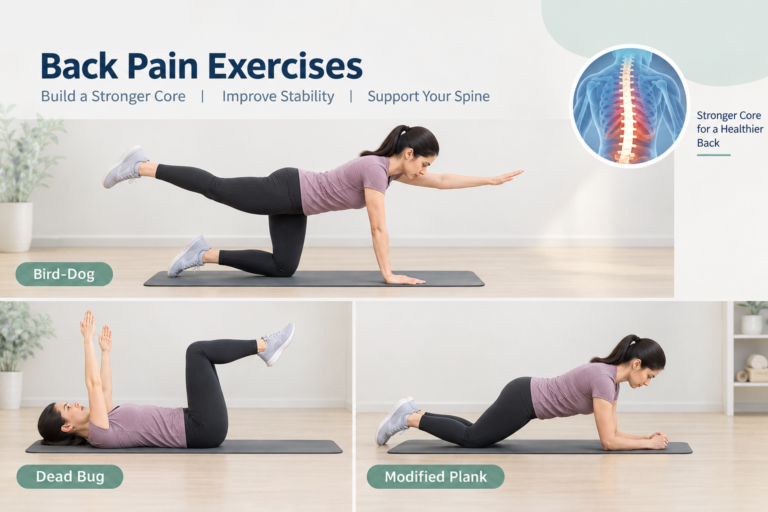
For mechanical low back pain (the most common type): Core stabilization exercises like bird-dogs, dead bugs, and modified planks retrain the deep stabilizing muscles, particularly the transversus abdominis and multifidus, which tend to switch off after even a few days of pain. These muscles don’t move the spine. They hold it steady, and weak stabilizers are why simple movements like bending to pick up a bag suddenly trigger a flare.
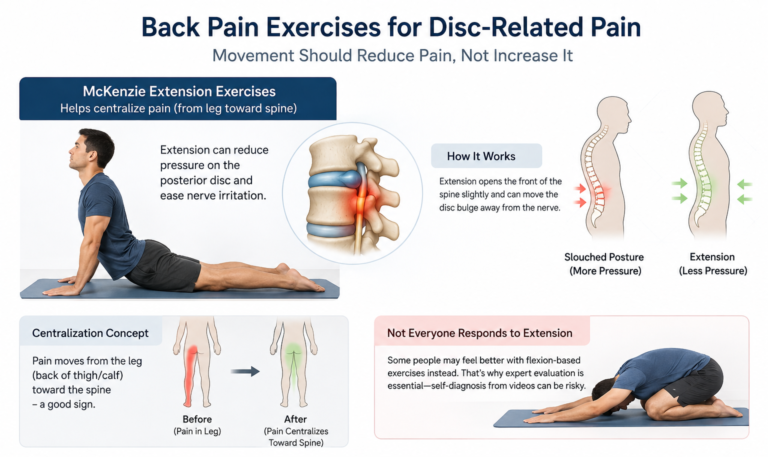
For disc-related pain with or without leg symptoms: Controlled extension exercises, the basis of the McKenzie protocol, often help centralize pain, meaning it retreats from the leg back toward the spine. This works because extension can reduce pressure on the posterior disc material where herniations typically push against a nerve root. Not every patient centralizes with extension. Some need flexion-based approaches instead, which is why self-diagnosing from a video is risky.
For general deconditioning and chronic pain: Graded walking, starting at 10 minutes and building to 30, improves disc nutrition (discs get their nutrients through movement, not blood flow) and reduces the fear-avoidance cycle that keeps many patients inactive long after the tissue has healed.
Most patients see a 30 to 50% improvement in pain scores within 4 to 6 weeks of a correctly matched exercise program, according to outcome data commonly cited in spine physiotherapy literature. That’s not instant, and it’s not universal, but it’s the realistic timeline worth setting expectations around.
Exercise is the foundation, not the entire structure. When pain persists past 6 weeks despite a proper program, or when there’s significant nerve involvement, we layer in other treatment for back pain: targeted spinal injections (epidural steroid or nerve root blocks) to calm inflammation enough that exercise therapy can actually work, manual therapy to address joint stiffness that limits movement quality, and in a small minority of cases, minimally invasive procedures for disc herniations that aren’t responding to conservative care.
Here’s the counterintuitive part: surgery is rarely the answer, and rest is rarely the answer either. Roughly 90% of acute low back pain cases resolve with conservative management alone. The patients who end up needing procedural or surgical intervention are usually the ones with confirmed nerve compression on MRI, not the ones with “just bad pain.”
Not all back pain symptoms are equal, and treating them the same way delays proper care. Watch for:
Exercise and home care handle most back pain, but certain patterns need professional evaluation, not more stretching:
Back pain treatment exercises work, but only when they’re matched to what’s actually causing your pain rather than borrowed from a generic list. The right movements can meaningfully reduce pain within weeks, while the wrong ones, even done with good intentions, can keep you stuck longer than necessary. If your pain hasn’t responded to appropriate exercise after 6 weeks, or if you’re seeing any of the red flag symptoms above, a specialist evaluation is the clearest next step.
Verified by:

M.S ( Ortho), F MISS, F CV
Dr.Saijyot Raut is a consultant spine surgeon with 10+ years of expertise in minimally invasive spine surgery, scoliosis and complex spinal disorders. He is part of One Spine team which has branches all over Mumbai and practises across leading hospitals in Mumbai
Gentle exercises such as walking, pelvic tilts, knee-to-chest stretches, and core-strengthening exercises can help relieve back pain and improve mobility. The best exercise depends on the cause and severity of your pain.
Yes, but the type of movement matters more than intensity. Gentle walking and specific stabilization exercises are usually safe even with severe pain. What you should avoid is prolonged bed rest, which weakens supporting muscles and slows recovery.
Avoid exercises that increase your pain, especially heavy lifting, deep forward bending, high-impact activities, and poorly performed twisting exercises. If you have severe or persistent pain, consult a spine specialist or physiotherapist before exercising.
Most patients notice a meaningful reduction in pain within 2 to 3 weeks if the exercises match their specific condition. Full functional improvement typically takes 4 to 6 weeks of consistent practice.
Only short-term, and only if your clinician recommends it for a specific activity. Long-term belt use can weaken the very stabilizing muscles you're trying to strengthen through exercise.