

Lower left back pain is a common problem that people often ignore. It might feel like stiffness after a long day, soreness from sitting too much, or a muscle strain. But when the pain becomes severe, if pain lasts or spreads, it usually means your body is trying to tell you something important.
The challenge is that the lower left side of your back is a surprisingly complex region. It sits adjacent to your kidney, near your colon, close to reproductive organs in women and is supported by a dense network of muscles, nerves, and lumbar vertebrae. Any one of these structures or several in combination can be the source of what feels like the same dull or stabbing ache.
This guide walks you through the symptoms of severe lower left back pain, what they might indicate, when to be concerned and what typically helps whether you’re a woman trying to understand why this keeps happening around your cycle or someone whose left-sided back pain came on suddenly and hasn’t let up.
Before getting into causes, first you need to understand that lower left back pain isn’t just one sensation. Patients describe it in remarkably different ways depending on what’s driving it:
A deep, aching pain that’s constant and doesn’t fully go away with rest often suggests a structural or muscular issue. A sharp, stabbing pain that comes in waves and may radiate to the groin or abdomen can point toward a kidney stone. A burning or electric shooting pain that travels down the left buttock and into the leg is characteristic of sciatic nerve involvement. A cramping pain that seems to worsen around menstruation in women may be connected to gynaecological causes rather than the spine itself.
The location matters too. Pain lower left side above the hip often involves the iliolumbar ligament, the sacroiliac joint, or the L4-L5 disc level all common sources of mechanical lower back pain. Pain that sits higher up, in the upper left side of the back, is more likely to involve the thoracolumbar junction, the left kidney, or the muscles around the lower rib cage.
Severe lower left back pain rarely comes alone. The accompanying symptoms are often what help clinicians identify the underlying cause. Here’s what to pay attention to:
Stiffness and reduced range of motion difficulty bending forward, twisting, or rising from a seated position suggests a musculoskeletal origin. This is typically worse in the morning and eases somewhat with gentle movement throughout the day.
Radiating pain into the left leg or foot when the pain travels down the leg along a defined path (often the outer thigh, calf, or into the foot), this is called radiculopathy. It indicates nerve root compression, most commonly at the L4, L5, or S1 levels. In lay terms, this is often referred to as sciatica, though true sciatica specifically involves the sciatic nerve.
Pain that worsens with prolonged sitting or standing mechanical lower back pain is heavily position-dependent. If your pain builds after sitting at a desk for hours or standing on a hard floor, the lumbar spine and surrounding muscles are the likely culprits.
Abdominal discomfort or bloating alongside back pain the left side of your colon sits directly in front of your lower left back. Conditions like constipation, diverticulitis, or irritable bowel syndrome can genuinely cause left lower back pain that feels entirely spinal in origin.
Flank pain with urinary changes if your lower left back pain is accompanied by a frequent urge to urinate, burning during urination, blood in the urine or fever, a kidney infection (pyelonephritis) or kidney stone should be ruled out promptly. Kidney related pain tends to sit a little higher typically just below the left rib cage and often has a colicky, wave-like quality.
Fever and general malaise with back pain this combination should always prompt urgent evaluation. It can indicate a kidney infection, spinal infection (discitis or epidural abscess), or in rare cases a serious intra-abdominal process
Women who experience lower left back pain particularly recurring or cyclical pain often have a broader differential diagnosis than men, and this is not discussed nearly enough.
Endometriosis is one of the most underdiagnosed causes of chronic lower left back pain in females. When endometrial tissue grows outside the uterus and attaches to structures near the spine, sacrum, or left ovary, it causes deep, often severe pelvic and back pain that worsens significantly during menstruation. Many women spend years being treated for “muscular back pain” before endometriosis is identified.
Ovarian cysts particularly on the left ovary can cause a dull to sharp pain in the lower left side that radiates into the back and hip. Large cysts or ruptured cysts cause more acute, severe pain.
Uterine fibroids, depending on their position, can press on nearby structures and generate a persistent lower back ache that’s easy to misattribute to a lumbar disc problem.
Pelvic inflammatory disease (PID) causes lower abdominal and back pain, often bilateral but sometimes more pronounced on one side, and is typically accompanied by fever, abnormal discharge, and pain during intercourse.
Progesterone and relaxin hormones that fluctuate across the menstrual cycle and surge during pregnancy affect ligament laxity throughout the body, including in the sacroiliac joints and lumbar region. This is why many women notice that their left lower back pain fluctuates predictably with their cycle, even when the spine itself is structurally normal.
For women asking what causes left lower back pain in females specifically the honest answer is that the causes range from the purely musculoskeletal to the hormonal to the gynecological and sometimes, it’s a combination of all three working together.
In men, lower left back pain follows a similar musculoskeletal pattern lumbar disc degeneration, muscle strain, and nerve compression are the most frequent causes. However, a few causes are worth specifically mentioning:
Left sided kidney stones are somewhat more common in men and can cause severe, colicky flank pain that radiates to the groin and inner thigh pain so severe it’s frequently described as among the worst a person can experience.
Prostatitis can occasionally cause referred pain into the lower back and perineal region, though it more commonly presents with urinary symptoms.
Otherwise, the mechanical and neurological causes of lower left back pain in males are largely the same as in the general population
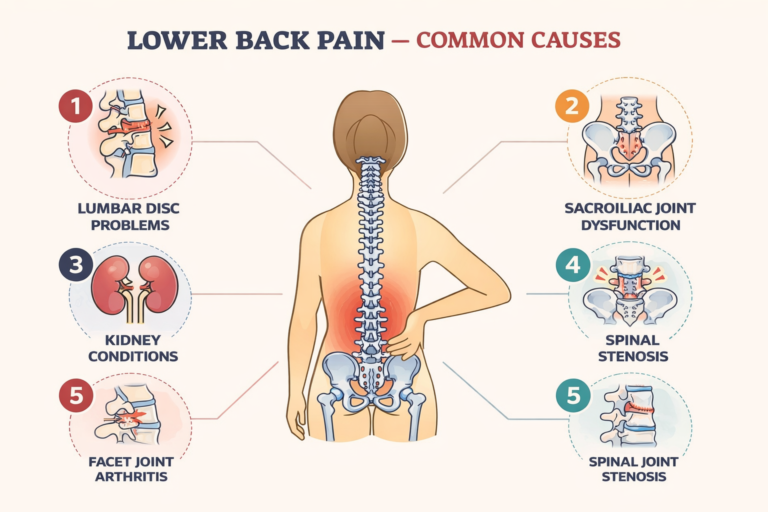
This is the single most common cause of lower left back pain across all age groups and genders. The erector spinae, quadratus lumborum, and multifidus muscles run along the lower back, and overuse, sudden awkward movements, or poor lifting mechanics can strain these muscles significantly. The pain is typically localized, worsens with movement, and usually resolves within a few weeks with appropriate care.
The intervertebral discs at L4-L5 and L5-S1 are the most commonly affected in the lumbar spine. A herniated or bulging disc on the left side can compress the adjacent nerve root, producing left-sided lower back pain with or without radiating leg symptoms. This tends to be sharper and more nerve-like in character compared to pure muscle pain.
he intervertebral discs at L4-L5 and L5-S1 are the most commonly affected in the lumbar spine. A herniated or bulging disc on the left side can compress the adjacent nerve root, producing left-sided lower back pain with or without radiating leg symptoms. This tends to be sharper and more nerve-like in character compared to pure muscle pain.
As mentioned earlier, the left kidney sits in the posterior abdomen just above the lower left back. Kidney stones, infections, or rarely tumors can all generate pain in this region. Distinguishing kidney pain from spinal pain is important: kidney pain tends to be deeper, may be accompanied by systemic symptoms, and doesn’t typically change with positional shifts the way musculoskeletal pain does.
As mentioned earlier, the left kidney sits in the posterior abdomen just above the lower left back. Kidney stones, infections, or rarely tumors can all generate pain in this region. Distinguishing kidney pain from spinal pain is important: kidney pain tends to be deeper, may be accompanied by systemic symptoms, and doesn’t typically change with positional shifts the way musculoskeletal pain does.
The facet joints are small paired joints that run along the back of the spine. Degenerative arthritis of the left lumbar facet joints produces a localized, deep ache in the lower left back that’s often worse with extension (bending backward) and prolonged standing.
Most lower left back pain resolves within a few weeks. But certain symptoms should prompt you to seek medical attention without delay.
See a doctor urgently if your lower left back pain is accompanied by:
In women specifically, if the lower left back pain is severe and cyclical, or accompanied by pelvic pain, heavy periods, or pain during intercourse, a gynaecological evaluation should be part of the workup not an afterthought.
Treatment depends entirely on what’s causing the pain, which is why an accurate diagnosis comes first. That said, here’s how the most common causes are typically managed:
For musculoskeletal causes physiotherapy remains the cornerstone of treatment. A targeted program addressing lumbar strengthening, flexibility, and postural correction yields lasting results for most patients. Short-term use of NSAIDs can manage acute pain, and muscle relaxants may help when significant spasm is present.
For disc-related nerve pain physiotherapy, nerve-specific medications and epidural steroid injections are options depending on severity. Surgery is considered when conservative treatment fails or when significant neurological compromise is present.
For kidney stones small stones often pass with adequate hydration and pain management. Larger stones may require urological intervention (lithotripsy or ureteroscopy).
For gynecological causes in women treatment varies significantly. Endometriosis may require hormonal therapy or surgical management. Ovarian cysts are often monitored, with intervention based on size and symptoms.
For sacroiliac joint dysfunction manual therapy, SI joint injections, and targeted stabilization exercises are effective in most cases.
At home, heat therapy applied to the lower left back can significantly relieve muscular pain and spasm. Gentle movement even a short walk is usually better than complete rest for most forms of mechanical back pain.
Severe lower left back pain is not something to push through and ignore indefinitely. Whether it’s coming from a strained muscle, a compressed nerve, a kidney or particularly in women a gynaecological source, it’s telling you that something needs attention.
The symptoms surrounding your pain are just as important as the pain itself. Pay attention to when it comes on, what makes it better or worse, and whether anything else in your body has changed. That information is invaluable to any clinician trying to help you.
Getting the right diagnosis early doesn’t just relieve your pain faster it prevents the kind of chronic, treatment-resistant back pain that develops when the underlying cause is managed incorrectly for too long.